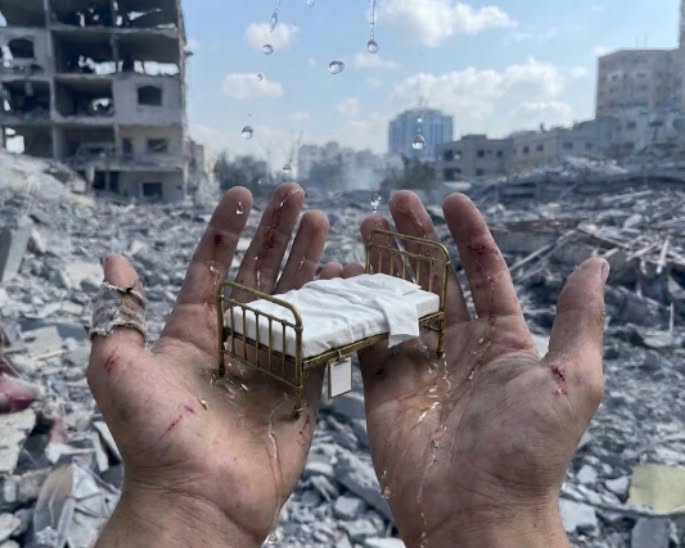
«Niente cena stasera» / Dormi, figlio mio — / niente cena stasera. / Puoi ingannare la tua fame, / sognando un po’ di pane. / Bere le tue lacrime salate / potrebbe placare il suo dolore lancinante. / Vorrei poterti aiutare, figlio mio — / ma sono un padre inerme. / La notte è abbastanza buia / da nascondere il tuo dolore. / Il mondo è abbastanza sordo / da ignorare le tue grida. / Dormi, figlio mio. / Vorrei portarti la falce di luna / come una banana morbida e dolce, / e le stelle lucenti / come piccoli pezzetti di caramella. / Vorrei regalarti il mondo, / come un pallone sotto i tuoi piedi. / Ma ancora — sono un padre inerme. / Dormi, figlio mio, / potresti finire per essere un martire domani, / un numero aggiunto alle migliaia. / E come al solito, / il mondo emetterà comunicati, / eppure si accorgerà molto più rumorosamente / di un asino smarrito / che di un bambino affamato.
”No dinner tonight” / Sleep, my son — / no dinner tonight. / You can deceive your hunger, / dreaming of some bread. / Drinking your salty tears / may hush its piercing pain. / I wish I could help you, my son — / but I am a helpless father. / The night is dark enough / to conceal your pain. / The world is deaf enough / to ignore your cries. / Sleep, my son. / I wish I could bring you the crescent moon / as a soft, sweet banana, / and the shining stars / as little pieces of candy. / I wish I could gift you the world, / as a ball beneath your feet. / But still — I am a helpless father. / Sleep, my son, / you might end up a martyr tomorrow, / a number added to the thousands. / And as usual, / the world will issue statements, / yet grieve much louder / for a missing donkey / than for a starving child.
La poesia come strumento per denunciare la distruzione causata dalla guerra. Il mondo è prigioniero dell’odio e i bambini innocenti pagano il caro prezzo di una società che ha dimenticato la pace. I bambini hanno bisogno di una casa, di giocare, di gioire tra le meraviglie della natura, invece vedono solamente macerie. La poesia deve abbattere le bandiere e costruire ponti di dialogo. Vogliamo gridare a chi detiene il potere di guardare con gli occhi della coscienza e chiedersi se fossero loro al posto di anime innocenti come si sentirebbero. I poeti di ogni lingua dovrebbero unirsi abbattendo i muri del dissidio e creare parole che facciano tremare il cuore, non di paura ma di amore.
Oltre il suono delle bombe: l’inerme coraggio della pace
C’è un dolore senza misura, un abisso che nessuna parola può contenere: è quello di un padre che guarda le sue mani vuote e non ha un pezzo di pane da offrire a suo figlio. Assistere alla fame di un bambino, alla sua paura e all’impotenza di non poterlo proteggere dal rumore assordante delle bombe significa calpestare la radice più profonda della dignità umana.
Eppure, coloro che si consumano sotto cieli lacerati dalla violenza non sono i volti di chi decide la guerra, ma le vite di chi la subisce. I conflitti non appartengono mai ai popoli; nascono nei palazzi del potere, dove si tracciano confini e si muovono pedine, ignorando lo sguardo terrorizzato di un bambino che cerca riparo nella notte. I confini non sono altro che linee immaginarie, strategie di dominio che creano l’illusione di dividere ciò che è naturalmente condiviso.
Di fronte a questa barbarie, la retorica della “vittoria sull’altro” rivela tutta la sua miseria. Non abbiamo bisogno di vincitori né di bandiere che sventolano sulle macerie: abbiamo disperatamente bisogno di riconciliazione. La pace non è la temporanea assenza di un conflitto armato, ma il coraggioso riconoscimento che siamo tutti ospiti di passaggio in questo mondo.
La diversità tra le culture non deve essere un pretesto per erigere muri, ma un terreno fertile per l’integrazione e lo scambio. La storia ci insegna che il progresso umano fiorisce nell’incontro, non nell’annientamento reciproco. Vogliamo vedere fiorire un’autentica pace, fatta di mani che si stringono, di storie che si intrecciano, di popoli che scelgono la cooperazione anziché l’oppressione. Sognare un mondo in cui i popoli si tengono per mano non è un’utopia ingenua: è l’unica via di sopravvivenza per l’umanità. È tempo di restituire la dignità ai padri, un futuro ai bambini e una voce a coloro che, nel silenzio assordante dell’indifferenza, continuano a sperare nell’alba della pace.
Transilation
A poem of heartbreaking power, striking straight to the stomach and the heart. The verses paint with cruel delicacy a reality of extreme suffering, where the tragedy of war and poverty is filtered through the helpless gaze of a father.
Here are some central aspects that emerge from this text:
The contrast between the innocence of childhood and the brutality of reality: The father tries to sweeten his son’s hunger by using the purest imagery from a child’s world — the moon as a banana, the stars as candy, the world as a ball to kick. It is a desperate attempt to offer refuge in fantasy, which immediately clashes with the harshness of daily survival.
Helplessness and loneliness: The father figure is stripped of all protective power. He cannot feed his son, he cannot stop the night, and he cannot protect him from an already written tomorrow. The repetition of the phrase “I am a helpless father” highlights the tragic failure of a fundamental role: protecting and nourishing one’s own child.
The final indictment: The closing lines are a sharp strike against the world’s indifference. The final comparison — cold, cynical, yet tragically real — exposes the hypocrisy of a global society capable of being moved or outraged by trivialities or marginal tragedies, while remaining deaf and distracted in the face of the silent death of children.
It is a text that needs no grand rhetoric: it uses the simplicity of words to denounce a deep collective wound, leaving the reader in a state of painful reflection.Beyond the Sound of Bombs: The Unarmed Courage of Peace
There is a pain without measure, an abyss for which no words can contain it: it is that of a father who looks at empty hands and has no piece of bread to offer his son. To witness a child’s hunger, their fear, and the helplessness of not being able to protect them from the deafening noise of bombs means trampling upon the deepest root of human dignity.
Yet, those who consume away beneath skies torn apart by violence are not the faces of those who decide war, but the lives of those who suffer it. Conflicts never belong to peoples; they are born in the halls of power, where borders are drawn and pawns are moved, ignoring the terrified gaze of a child seeking shelter in the night. Borders are nothing more than imaginary lines, strategies of domination that create the illusion of dividing what is naturally shared.
In the face of this barbarism, the rhetoric of “victory over the other” reveals all its wretchedness. We do not need victors or flags waving over the rubble: we desperately need reconciliation. Peace is not the temporary absence of armed conflict, but the courageous recognition that we are all passing guests in this world.
Diversity among cultures must not be a pretext for raising walls, but fertile ground for integration and exchange. History teaches us that human progress flourishes in encounter, not in mutual annihilation. We want to see authentic peace blossom, made of hands holding one another, of stories intertwining, of peoples choosing cooperation rather than oppression.
Dreaming of a world where peoples hold hands is not a naive utopia: it is humanity’s only path to survival. It is time to restore dignity to fathers, a future to children, and a voice to those who, in the deafening silence of indifference, continue to hope for the dawn of peace.
